Skip to Content
COVID-19 Response and Update

Parkinson’s Disease

Parkinson’s disease is the fastest growing neurological disorder worldwide, affecting over 1.1 million people in the U.S.

Parkinson’s disease (PD) is a progressive disorder of the central nervous system resulting from a loss of dopamine-producing brain cells that affect movement. It’s characterized by slowness, stiffness, resting tremor, speech changes, impaired balance, and potentially nonmotor symptoms like anxiety, depression, and challenges with thinking and memory. While it’s not considered a fatal disease, it is associated with significant morbidity and disability, and complications from PD can challenge vital activities like eating and sleeping.

Parkinson’s disease has become the fastest growing neurological disorder worldwide, with approximately one million people diagnosed in the U.S. The average age at diagnosis for people with PD is 60; as people live longer, the number of people living with PD is predicted to grow significantly over the coming decades. Beyond age, family history, exposure to some toxins, and being male are potential risk factors.

New Parkinson’s diagnoses every year

90,000

Source: Parkinson’s Foundation

How frequently someone new is diagnosed with Parkinson’s Disease in the U.S.

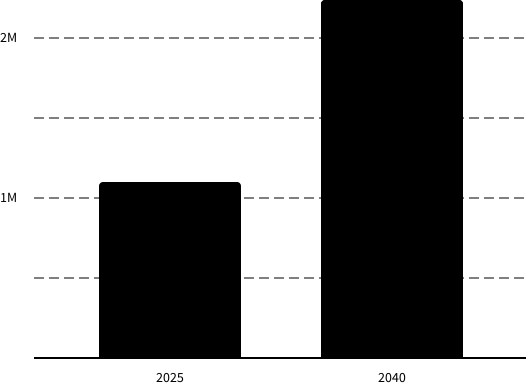
The prevalence of Parkinson’s disease in America is set to double by 2040:
diagram

Source: National Library of Medicine

There is no cure, but there are more and better ways to treat symptoms, including everything from aerobic exercise to medications and devices and surgeries. Nevertheless, Parkinson’s disease is a chronic, high-burden disease to live with, with uneven access to movement disorder specialists, treatment continuity, and treatment options. Hope and opportunity comes from greater awareness, which helps drive more scientific study and community support.


Accessibility trends

Parkinson's disease remains challenging to live with, but access to care and support is improving

Affordability

Improving
Parkinson’s care is costly, and treatment costs vary widely based on insurance design, drug formulation, and geography. Generic medicines play an important role in moderating costs for many foundational Parkinson’s therapies, helping improve affordability and long-term access. However, financial and insurance barriers continue to limit affordability, especially for those relying on fixed incomes or disability benefits.
Parkinson's Disease medications alone cost an average of $2,500 per year per person
$2500
Medicare coverage plays a major role in Parkinson’s care, covering approximately 90% of people living with the disease in the U.S.
90%

Availability

Stable
Most people with Parkinson’s do not see a movement‑disorder specialist and many are managed in general neurology or primary care, reflecting limited specialist capacity. Telehealth, e‑consults, and outreach clinics are starting to expand reach, but there’s still a continued need for investment to make multidisciplinary care truly accessible. For most commonly used medications, wholesale production and global distribution are relatively mature and stable
Number of Parkinson’s Disease patients in the U.S.
1.1 Million
Proportion of PD patients who see a movement disorder specialist
9%
Median number of miles many PD patients travel to see a specialist
1
0
0

Innovation

Accelerating
After years of mainly symptomatic therapies, Parkinson’s research is now pushing into adaptive devices, biologics, gene‑ and cell‑based approaches, and disease‑modifying strategies. New technologies like adaptive deep brain stimulation (aDBS) have gained FDA approval and parallel advances in nanomedicine, gene therapy, and CRISPR‑based approaches are being explored as part of a new era in Parkinson’s neurological care.
Clinical trials currently in development globally for Parkinson’s disease
136+
Parkinson's DBS treatment video

Knowledge

Improving
Parkinson’s knowledge and support have grown through national organizations, awareness months, and structured care resources for patients and caregivers. However, there is still an associated stigma and gaps in understanding Parkinson’s which underscore that education and caregiver support must scale.

Amneal’s commitment to the Parkinson’s community

Dedicating decades to innovation and support for the Parkinson’s community

For decades, Amneal has been committed to advancing care for people living with Parkinson’s disease, building a portfolio of treatments designed to meet patients’ evolving needs over time.

CREXONT® (carbidopa and levodopa) extended-release capsules represents the latest innovation in that effort— a novel extended-release, dual-component capsule engineered to deliver more sustained “Good On” time with less frequent dosing than IR CD/LD. For people navigating mobility challenges, slowness, or stiffness, this added duration of benefit may translate into less time with the burden of PD motor symptoms, and more moments that feel like themselves again.

Patient
"The approval of CREXONT is a seminal moment in the treatment paradigm for Parkinson's disease. Amneal is so excited to introduce this meaningful new treatment for Parkinson's patients in the U.S. and soon internationally. We are committed to continuing to advance Parkinson's research and development as a leader in the space."
Joe Renda
Senior Vice President, Chief Commercial Officer – Specialty
Amneal has been dedicated to supporting the Parkinson’s community for more than 15 years
Patients in the United States who have been prescribed CREXONT
30,000+
Data on file. Amneal Pharmaceuticals LLC.
Amount of insurance coverage we’ve been able to help expand for our innovative Parkinson’s treatments in the last year alone
>20%
Number of Amneal employees who walked in the Michael J. Fox Parkinson’s Unity Walk in 2024
150

We hosted a Lunch & Learn for our U.S. employees with Dr. Torres-Yaghi, MD, and Dr. Pagan, MD, two respected Movement Disorder Specialists from MedStar Georgetown University Hospital who shared valuable insights into Parkinson’s disease.

Amneal’s financial commitment to supporting patient assistance foundations in Parkinson's since 2025
$3.5M
Amneal SPARK program

Amneal Patient Assistance Program (PAP)

Learn more (Opens in a new window)

The information presented in this Accessibility Index is compiled from publicly available sources believed to be reliable at the time of publication. However, Amneal makes no representations or warranties, express or implied, regarding the accuracy, completeness, or timeliness of the data provided. The content is for informational purposes only and does not constitute professional advice or endorsement.

The views and opinions expressed in this index do not necessarily reflect those of Amneal, its affiliates, or its employees. Amneal disclaims any liability for any decisions made or actions taken based on the information contained herein.

This index is intended to support awareness and understanding of medicine accessibility and is not a substitute for professional consultation or regulatory guidance. Users are encouraged to verify information independently and consult appropriate experts before making decisions.

By using this site, you acknowledge and agree to these terms.

INDICATION

CREXONT® (carbidopa and levodopa) extended-release capsules is a prescription medication for the treatment of Parkinson’s disease, Parkinson’s disease caused by infection or inflammation of the brain, or Parkinson’s disease-like symptoms that may result from carbon monoxide or manganese poisoning in adults.

IMPORTANT SAFETY INFORMATION

Do not take CREXONT with antidepressant medications known as nonselective monoamine oxidase (MAO) inhibitors.

Do not take CREXONT with other carbidopa-levodopa preparations without consulting your healthcare provider.

CREXONT may cause falling asleep during activities of daily living, somnolence, or dizziness. Avoid activities that require alertness such as driving and operating machinery until you know how CREXONT affects you.

Your doctor should evaluate vitamin B6 levels before and during treatment with carbidopa/levodopa therapies as seizures associated with low levels of vitamin B6 have been reported. Traditional anti-seizure medications were not effective, and seizures were only resolved after vitamin B6 administration. Other symptoms of vitamin B6 deficiency include depression, confusion, cracked corners of the mouth, swollen tongue, skin inflammation, low red blood cell count, and/or numbness, tingling, or weakness in the extremities. Your doctor may advise you to take vitamin B6 as necessary.

The most common side effects that may occur with CREXONT are nausea and anxiety.

It is important to avoid sudden discontinuation or rapid dose reduction of CREXONT. If you are discontinuing CREXONT, work with your healthcare provider to taper the dose over time to reduce the risk of fever or confusion.

You may take CREXONT with or without food, but taking it with food may decrease or delay its effect. Consider taking the first dose of the day about 1 to 2 hours before eating.

Swallow CREXONT whole. Do not chew, divide, or crush CREXONT capsules. If you have difficulty swallowing the capsule, twist apart both halves and sprinkle the entire contents of both halves of the capsule on a small amount of applesauce (1 to 2 tablespoons). Consume the mixture immediately. Do not store the drug/food mixture for future use.

Do not take CREXONT with alcohol.

Tell your healthcare provider if you:

  • Have any heart conditions, especially if you have had a heart attack or irregular heartbeats
  • Experience hallucinations or abnormal thoughts and behaviors
  • Have an inability to control urges to gamble, have increased sexual urges, or experience other intense urges
  • Have thoughts of suicide or have attempted suicide
  • Have abnormal involuntary movements that appear or get worse during treatment
  • Have ever had a peptic ulcer or glaucoma
  • Become or intend to become pregnant. Based on animal data, CREXONT may cause fetal harm
  • Are breastfeeding during therapy

To report SUSPECTED ADVERSE REACTIONS, contact Amneal Global Patient Safety at 1-877- 835-5472, or FDA at 1-800-FDA-1088 or  www.fda.gov/medwatch.

Please read the full Prescribing Information. For more information talk to your healthcare provider.