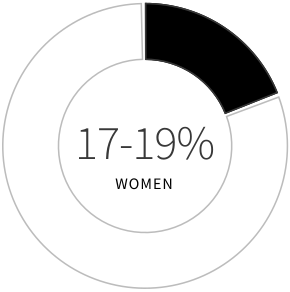
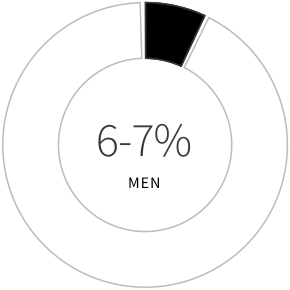
Headache disorders are characterized by recurrent headaches and impact over 40% of the global population. One of the most prevalent headache disorders is migraine. A migraine is more than just a headache; it’s a neurological disorder characterized by recurring episodes of moderate to severe head pain that can be deeply debilitating. Migraine is often described as throbbing or pulsating pain and may last from several hours to as long as 72 hours if left untreated. For many people, migraine makes it difficult to work, maintain relationships, enjoy hobbies, or manage basic self-care. A migraine attack is frequently accompanied by additional symptoms, including: nausea, vomiting, sensitivity to light, sound, smell, or touch.
Although cluster headaches share some similarities with migraine, they are a distinct neurological disorder with unique characteristics. Cluster headaches occur in short but intensely painful attacks, typically lasting 15 minutes to three hours, and often appear in recurring cycles or “clusters” over weeks or months. The pain associated with cluster headaches is sudden, severe, and piercing, usually concentrated on one side of the head, often in or around the eye. It is frequently noted as one of the most painful conditions a person can experience, described as a “red hot needle.” It can be accompanied by excessive tearing or redness of the eye, swelling around the eye, facial sweating or flushing, and nasal congestion or a runny nose on the affected side. Cluster headache affects approximately 1 in 1,000 people. Accurate diagnosis can be challenging, and many individuals are initially misdiagnosed, delaying appropriate treatment options.
Despite the severity and prevalence of migraine and cluster headache, treatment options have historically fallen short. Headache disorders are the fourth most common reason for emergency department visits in the United States. Yet, emergency care often exacerbates symptoms rather than relieves them—long wait times, bright lights, noisy environments, and rushed evaluations can intensify pain and distress for headaches.
Approximate number of people who suffer from cluster headaches in the U.S.
Source: Fischera M et al. Cephalalgia

Source: Headache
Source: Journal of Headache and pain
Source: Headache
Source: Neurology and Therapy
Source: Future Market Insights
Source: National Library of Medicine
Source: International Headache Society
Source: Headache
For people living with migraine and cluster headaches, the challenge extends beyond pain to include limited access to effective treatment options.
To help address this gap, Amneal introduced BREKIYA® (dihydroergotamine mesylate), the first and only DHE autoinjector for the acute treatment of migraine with or without aura and the acute treatment of cluster headaches in adults.(1,2) BREKIYA autoinjector is a ready-to-use, single-dose autoinjector that allows patients to self-inject directly into the thigh, enabling them to access treatment from the comfort of home. It can be effective at any point during an attack. With no refrigeration, assembly, or preparation required, it removes barriers to timely, effective treatment.
1. Brekiya [package insert]. Bridgewater, NJ: Amneal Pharmaceuticals LLC; 2025.
2. Data on file, Amneal Pharmaceuticals LLC.
“We are excited to introduce Brekiya autoinjector, making this innovative therapy broadly available to healthcare providers and patients. As the first and only self-administered, ready-to-use DHE autoinjector, Brekiya autoinjector offers patients the ability to treat debilitating attacks in a convenient way and may reduce visits to the emergency room. With our expanding neurology portfolio, Amneal is committed to supporting providers through comprehensive education and ensuring strong patient access as we bring Brekiya autoinjector to market.”Joe Renda
Source: National Headache Foundation
The information presented in this Accessibility Index is compiled from publicly available sources believed to be reliable at the time of publication. However, Amneal makes no representations or warranties, express or implied, regarding the accuracy, completeness, or timeliness of the data provided. The content is for informational purposes only and does not constitute professional advice or endorsement.
The views and opinions expressed in this index do not necessarily reflect those of Amneal, its affiliates, or its employees. Amneal disclaims any liability for any decisions made or actions taken based on the information contained herein.
This index is intended to support awareness and understanding of medicine accessibility and is not a substitute for professional consultation or regulatory guidance. Users are encouraged to verify information independently and consult appropriate experts before making decisions.
By using this site, you acknowledge and agree to these terms.
Serious or potentially life-threatening reductions in blood flow to the brain or extremities due to interactions between dihydroergotamine (the active ingredient in Brekiya autoinjector) with strong CYP3A4 inhibitors (such as protease inhibitors and macrolide antibiotics) have been reported rarely. As a result, these medications should not be taken together.
Tell your healthcare provider about all the medicines you take, including prescription and over-the-counter medicines, vitamins, and herbal supplements. Especially tell your healthcare provider if you take: sumatriptan, ergot-type medicine, saquinavir, nefazodone, fluconazole, grapefruit juice, zileuton, nicotine, propranolol or other medicines that can lower your heart rate, any medicines that can increase your blood pressure, selective serotonin reuptake inhibitors. These are not all of the medicines that could affect how Brekiya autoinjector works. Your healthcare provider can tell you if it is safe to take Brekiya autoinjector with other medicines.
Tell your healthcare provider if you have any side effect that bothers you or that does not go away. These are not all of the possible side effects of Brekiya autoinjector. Call your healthcare provider for medical advice about side effects.
Brekiya autoinjector is a prescription medicine used for the acute treatment of migraine with or without aura and the acute treatment of cluster headaches in adults.
Brekiya autoinjector is not used to prevent migraine or used to treat other types of headaches such as hemiplegic migraines (that make you unable to move on one side of your body) or basilar migraines (rare form of migraine with aura). It is not known if Brekiya autoinjector is safe and effective in children.
To report SUSPECTED ADVERSE REACTIONS, contact Amneal Specialty, a division of Amneal Pharmaceuticals LLC at 1‑877‑835‑5472, or FDA at 1‑800‑FDA‑1088 or www.fda.gov/medwatch. (Opens in a new window)
Please see full Prescribing Information (Opens in a new window), including Boxed Warning, Medication Guide (Opens in a new window) (Opens in a new window), and Instructions for Use.